

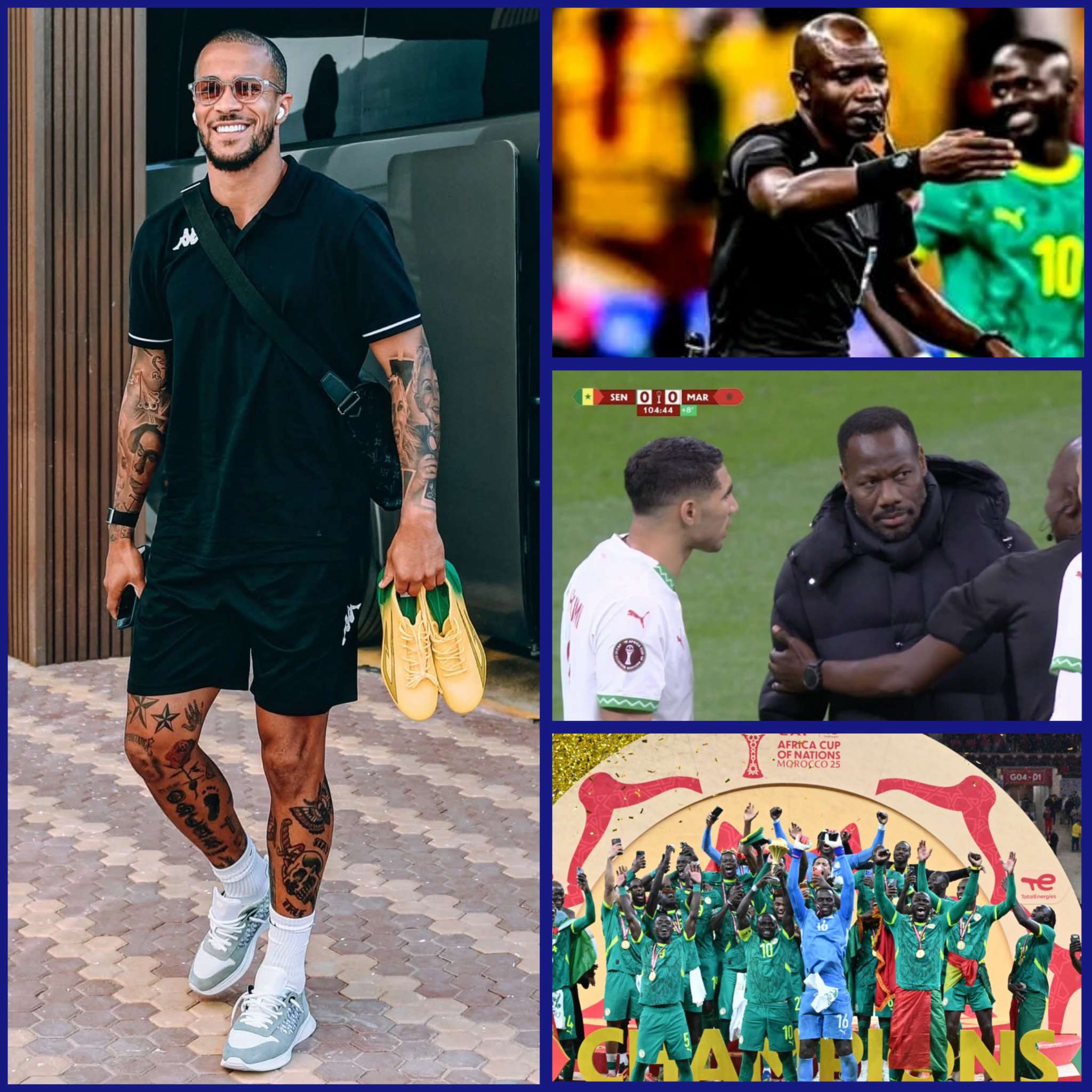
Nigerian defender William Troost Ekong has offered a measured but pointed perspective on the ongoing Africa Cup of Nations controversy, weighing in on the dispute between Senegal and Morocco that has consumed African football for two months.
The Super Eagles vice-captain, known for his thoughtful commentary on and off the pitch, shared his analysis of the chaotic final and its aftermath.Speaking on the issue that has divided the continent, Troost Ekong addressed both the conduct of players during the final and the subsequent administrative decision that stripped Senegal of their title.
Watching the Chaos Unfold
I watched the final and saw the moment when Senegal walked off the pitch,” Troost-Ekong said, referencing the dramatic stoppage-time incident that has since become the subject of legal battles and moral debates.
The Nigerian center-back, who has faced Senegal in multiple high-stakes encounters including the 2019 AFCON final, brought the perspective of a player who understands the pressure of continental competition.
It was unsportsmanlike behaviour,” he stated plainly, acknowledging the widespread criticism of Senegal’s decision to leave the field following the award of a stoppage-time penalty to Morocco.
But the referee, Jean-Jacques Ndala had the power to stop the game and award Morocco a 3-0 victory at the time.”Troost-Ekong’s point highlights a crucial aspect of football’s laws: referees have the authority to abandon a match if a team refuses to play.
By not exercising that authority and instead facilitating the return of Senegalese players to the field, Ndala effectively chose to let the match continue under the original conditions.
The Central Argument
The Nigerian international then pivoted to what he sees as the core inconsistency in CAF’s subsequent handling of the matter.”The moment both sides agreed to carry on playing, the match must surely be decided by what happens on the pitch,” Troost-Ekong argued.
This position cuts to the heart of the controversy: if play resumed and was completed without further incident, should a post-match ruling override the result determined during those 90-plus minutes?, His reasoning aligns with the sporting principle that results should be settled between the white lines, not in boardrooms.
Senegal went on to win the match 1-0 in extra time, with Pape Gueye scoring the decisive goal after Diaz’s penalty was saved. For Troost Ekong and many observers, that outcome, achieved after both teams agreed to continue playing should stand.
A Balanced Critique
Notably, Troost-Ekong did not absolve Senegal of responsibility for the initial walk-off. By describing it as “unsportsmanlike behaviour,” he acknowledged the legitimacy of criticism directed at the Teranga Lions’ conduct.
However, he also suggested that CAF’s response—awarding the title to Morocco months later—exceeds what the rules were designed to address.The defender’s intervention is significant given his stature in African football.
A two-time AFCON participant and one of Nigeria’s most respected voices, Troost-Ekong has earned credibility through his own competitive encounters with both nations involved. His comments may reflect the views of many players who have watched the dispute unfold with growing frustration.
The Player Perspective
Troost Ekong’s intervention brings a crucial perspective often missing from administrative debates: that of the players who actually compete in these tournaments.
For those on the pitch, the idea that a title can be reassigned after the fact, based on legal interpretations rather than sporting outcomes, strikes at the fundamental nature of competition. His statement also implicitly supports the stance taken by players from both Morocco and Senegal who have rejected CAF’s rulings.
Moroccan defender Achraf Hakimi publicly refused the trophy awarded to his country, insisting Senegal won fairly. Senegalese captain Sadio Mané has reportedly refused to return his Best Player award, declaring he won it “on the pitch, not in the boardroom.
A Growing Consensus
Troost Ekong’s comments add to a growing chorus of voices within African football questioning CAF’s handling of the matter. While the Confederation has defended its application of regulations, the sporting logic that results should be determined by what happens during matches continues to resonate powerfully.
As Senegal prepares its appeal to the Court of Arbitration for Sport, the Nigerian defender’s words serve as a reminder that for many in the football community, the integrity of the competition rests not on regulatory technicalities but on the principle that matches are won and lost on the field.
The match must surely be decided by what happens on the pitch,” Troost-Ekong concluded. In a dispute defined by conflicting legal arguments, that simple proposition may prove the most difficult for CAF to answer.