

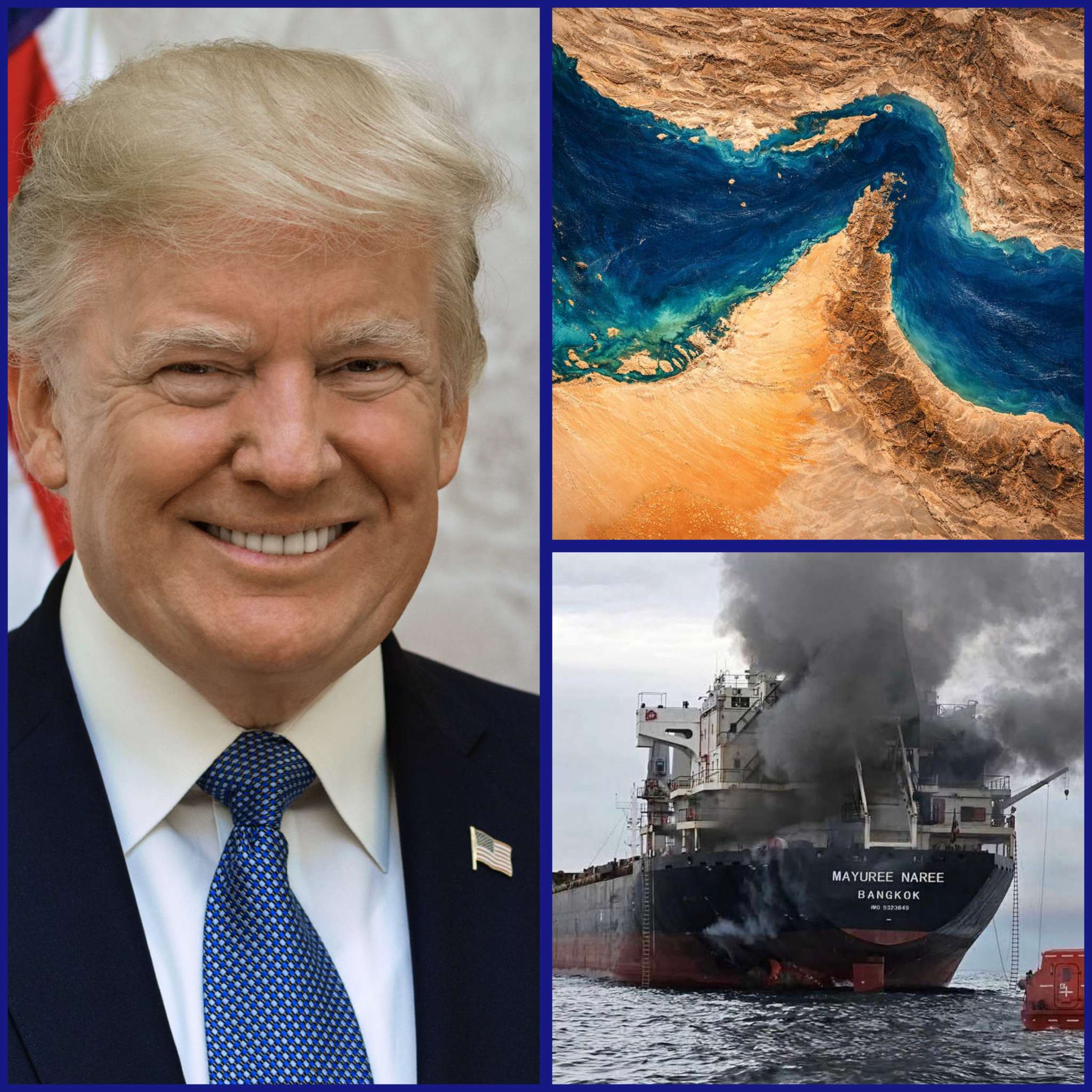
United States President Donald Trump has issued a direct call to commercial vessels, urging them to demonstrate courage and continue navigating through the strategic Strait of Hormuz despite escalating attacks and heightened regional tensions.
The appeal comes in the wake of reports that Iranian forces struck a Thai-flagged cargo ship attempting to transit the vital waterway, leaving multiple crew members missing and sparking fresh global concerns over maritime safety. The incident involving the Thai vessel “Mayuree Naree” has become a flashpoint in the ongoing conflict.
According to Thailand’s Ministry of Foreign Affairs, the cargo ship was hit and damaged while sailing through the Strait of Hormuz after departing from Khalifa Port in the United Arab Emirates, affecting 23 Thai crew members on board. Three sailors remain missing, believed to be trapped in the engine room following the attack.
Thailand has since summoned Iran’s ambassador to seek clarification and lodged a formal protest over the violence directed at commercial vessels .Trump, however, has dismissed the danger as manageable.
He told oil companies “they should” continue using the sea lanes, offering them better insurance coverage as an incentive . The President has promised to check Iranian forces in the strait by “taking it over,” if necessary, and has repeatedly emphasized that U.S. forces, the most powerful military in the world will prevail.
The President’s stance reflects what naval experts describe as “gunboat diplomacy,” reminiscent of colonial power tactics from the 1800s . Sal Mercogliano, a naval historian and maritime shipping expert at Campbell University, expressed skepticism about the approach. How they didn’t know this was going to happen is really mystifying… they should have been prepared,” he said, referring to the escalating maritime crisis .
The Strait of Hormuz, a narrow waterway between the Persian Gulf and the Indian Ocean, is one of the world’s most critical oil shipping routes, normally carrying nearly 20 percent of global oil production .
At its narrowest point, shipping lanes are no more than two kilometers wide, making it particularly vulnerable to disruption .Iran has declared the strait effectively closed to vessels associated with hostile nations. The Islamic Revolution Guards Corps (IRGC) has warned that any vessel destined for the U.S., Israel, or their “hostile partners” is now considered a “legitimate target.
Iranian military commanders have reiterated that they will not allow oil to leave the region as long as bombardment of Iranian cities continues .Since the U.S.-Israeli military campaign against Iran began on February 28, 2026, at least 17 commercial vessels have been hit in or near the Strait of Hormuz .
The attacks have left at least eight mariners dead and caused significant disruption to global shipping . Energy producers in Qatar and Kuwait have been forced to halt production or declare force majeure, warning that events beyond their control may lead them to miss export targets.
Naval experts question whether the U.S. can effectively re-establish safe shipping through the area. Retired Vice-Admiral Mark Norman of the Canadian navy points to Iran’s capacity for “maritime guerrilla warfare,” including the use of fast, well-armed speedboats, land-based anti-ship cruise missiles, and naval mines. Mines remain particularly dangerous, they are relatively cheap yet can cause catastrophic damage to warships and block the waterway for days or weeks if a vessel is sunk.
Donald Trump has claimed that U.S. forces destroyed 10 Iranian mine-laying vessels in the strait, warning that “more will follow” . Defense Secretary Pete Hegseth said U.S. Central Command had been eliminating the vessels “with ruthless precision” at Trump’s direction, adding that Iran had been “officially put on notice.
However, despite these operations, attacks on commercial shipping have continued unabated.The economic consequences are mounting. Global oil prices have surged from pre-war levels of approximately $72 per barrel to nearly $90, with Iran predicting prices could exceed $200.
The disruption extends beyond energy, about one-third of the world’s fertilizer supply also transits the strait, raising concerns about future food price inflation .The U.S. is reportedly considering a convoy scheme to escort commercial vessels through the strait, potentially starting by the end of March .
However, experts warn that even with protection, shipping volume would likely reach only 10 percent of normal flow due to the physical constraints of the waterway .
For now, Trump’s message to ship operators is clear: courage is required, and the passage must continue. But as the Strait of Hormuz transforms into a battlefield, that courage carries increasingly heavy risks for crews, for cargoes, and for global economic stability.