

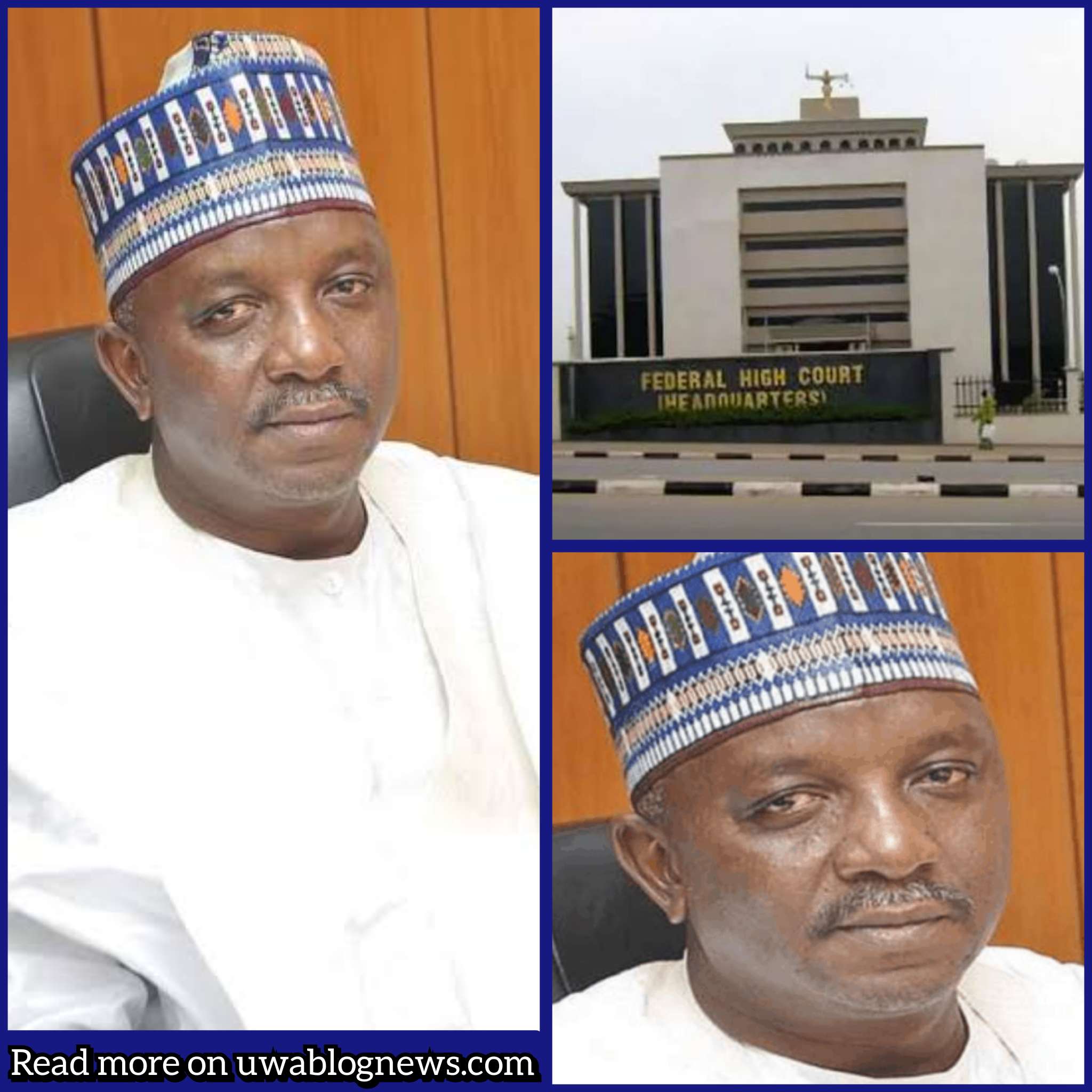
A Federal High Court sitting in Abuja has sentenced former Minister of Power, Saleh Mamman, to 75 years imprisonment for his involvement in a massive money laundering scheme involving ₦33.8 billion in public funds.
Justice James Omotosho convicted Mamman on all 12 counts of fraud and money laundering filed against him by the Economic and Financial Crimes Commission (EFCC), holding that the prosecution proved its case beyond reasonable doubt.
The court sentenced the former minister to seven years imprisonment on 10 of the counts, three years on count four, and two years on count five. Justice Omotosho ordered that the sentences run consecutively rather than concurrently, resulting in the total 75-year term.
A Landmark Conviction in Absentia Saleh Mamman
Mamman, who served as Power Minister under former President Muhammadu Buhari from August 2019 to September 2021, was convicted and sentenced in absentia after failing to appear in court.
His lawyer informed the court that calls to the former minister could not connect, prompting Justice Omotosho to describe Mamman’s absence as “a deliberate attempt to frustrate the administration of justice. Relying on the Administration of Criminal Justice Act, 2015, the court proceeded with sentencing despite the defendant’s absence.
The judge further ordered all security agencies, including Interpol, to arrest Mamman wherever he is found and hand him over to the Nigerian Correctional Service to begin serving his sentence. The jail term will officially commence on the date of his arrest .
Diversion of Power Infrastructure Funds
The charges centered on the laundering of ₦33.8 billion through private companies and Bureau de Change operators. Prosecutors established that the funds were diverted from government-financed hydroelectric projects, specifically the Mambilla and Zungeru power plants, critical infrastructure designed to address Nigeria’s chronic electricity shortages.
The evidence of the prosecution is overwhelming as against the scanty and almost absent defence of the defendant,” Justice Omotosho held. “Rather than creating a legacy to tackle the epileptic power supply in the country, the defendant was living large at the expense of ordinary citizens.
Little wonder that Nigerians have remained in darkness till today” .The court found that Mamman made a cash payment of $655,700 (approximately ₦200 million) for a landed property in Abuja without recourse to a financial institution, in violation of money laundering regulations.
Asset Forfeiture and Restitution
Beyond the prison sentence, the court ordered the final forfeiture of various foreign currencies recovered from the convict, as well as four choice properties in Abuja traced to him. Justice Omotosho further directed Mamman to refund the outstanding balance from the ₦22 billion that the prosecution proved was diverted from the power projects.
The judge noted that most of the funds were siphoned through Bureau de Change operators, who converted the naira into foreign currencies and handed them over to the defendant.
Mixed Reactions as Mamman Fights Separate Case
The conviction has drawn commendation from anti-corruption advocates. The Human Rights Writers Association of Nigeria (HURIWA) praised the EFCC and the judiciary for what it described as a landmark ruling that can strengthen accountability and public confidence in the justice system.
Meanwhile, Mamman faces a separate fraud trial at the FCT High Court in Maitama, where he and seven others are accused of diverting N31 billion meant for the Mambilla Power Project.
On Monday, another judge issued a bench warrant for his arrest in that case after he failed to appear in court .Ironically, just weeks before his conviction, Mamman had announced plans to run for Taraba State governor in the 2027 elections under the ruling All Progressives Congress (APC)