

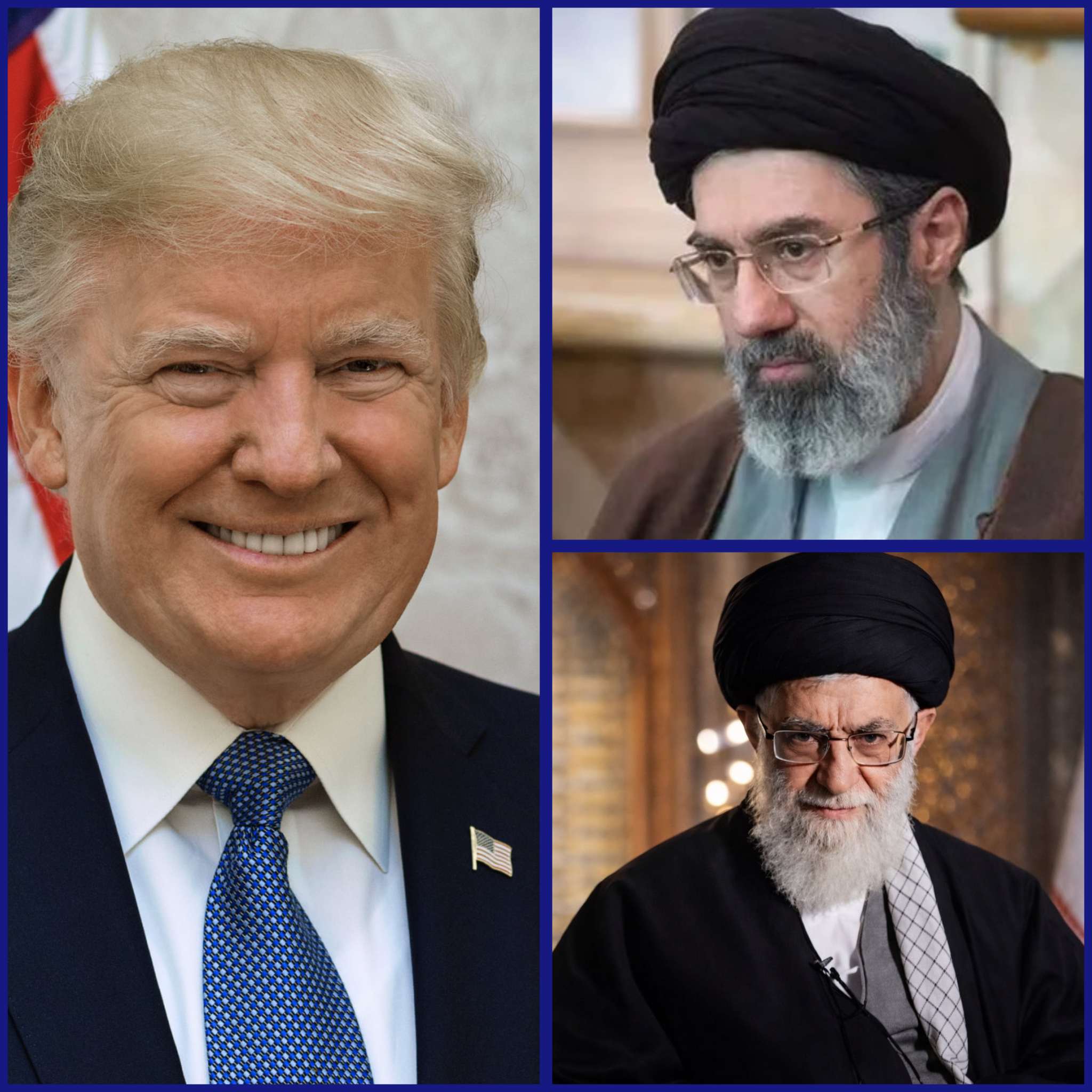
United States President Donald Trump has inserted himself into one of the most sensitive succession processes in the Middle East, declaring that he must be personally involved in selecting Iran’s next Supreme Leader following the death of Ayatollah Ali Khamenei.
In an interview with Axios, Trump made clear his opposition to any hereditary succession, specifically rejecting the possibility of Mojtaba Khamenei, the late leader’s son assuming the role.
Describing the younger Khamenei as “unacceptable,” Trump stated his preference for someone who would bring “harmony and peace to Iran.
The president drew parallels to his administration’s approach to Venezuela, suggesting that his involvement in Iranian political developments would mirror the pressure campaign waged against Nicolás Maduro’s government.
This comparison signals a potential continuation of the maximum pressure strategy that defined his administration’s Iran policy.
Trump’s remarks come at a particularly delicate moment for the Islamic Republic. Iranian officials have not yet officially announced a successor to Khamenei, who led the country for over three decades.
The succession process is governed by the Assembly of Experts, a body of 88 clerics constitutionally mandated to select, monitor, and potentially dismiss the Supreme Leader.
The president’s demand for involvement in what is fundamentally an internal Iranian religious and political process represents a significant escalation in rhetoric. It effectively challenges the foundational principle of Iran’s political system: that the Supreme Leader derives authority from religious credentials and clerical consensus, not foreign approval.
Regional analysts note that Trump’s intervention could have paradoxical effects. While intended to pressure Iran, it may strengthen hardliners who advocate for a successor resistant to external influence.
The comparison to Mojtaba Khamenei’s potential candidacy also highlights concerns within Iran about the institutionalization of leadership within a single family, a departure from the revolutionary ideal of leadership based on religious merit rather than bloodline.
Trump’s insistence on involvement raises immediate questions about mechanisms. The United States has no formal role in Iran’s succession process, and direct American intervention in such a sensitive internal matter is almost certain to provoke backlash across Iran’s political spectrum including among those who might otherwise oppose Mojtaba Khamenei’s succession.
The broader context cannot be ignored. Trump’s presidency was defined by maximum pressure on Iran: the withdrawal from the JCPOA nuclear deal, the assassination of General Qassem Soleimani, and crippling economic sanctions.
His renewed focus on Iranian leadership suggests that should he return to office, Iran policy would remain a central pillar of his foreign agenda.
For now, Iran’s leadership transition continues behind closed doors, insulated from Trump’s declarations. But his words serve as a reminder that whoever ultimately assumes the mantle of Supreme Leader will inherit not just domestic challenges, but the unrelenting scrutiny of the American president who believes Iran’s future is also his business.